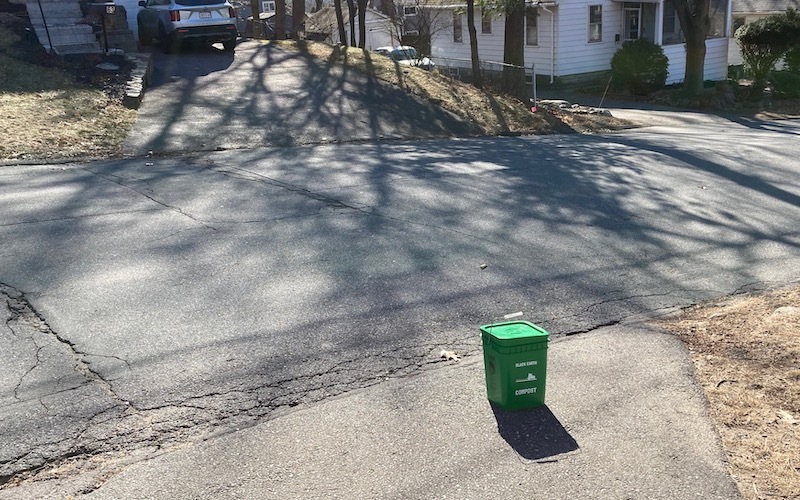
Curbside composting: Countering common concerns
Summary: composting by Hiranmayi
When: Feb 05, 2023
Time:17:00 - 16:00
Description
by Hiranmayi Narasimhan
If you haven’t already, it’s time to jump on the bandwagon for curbside composting. For those of us new to the idea, composting is using help from bacteria and worms to decompose the leftover food scraps from our tables and kitchens.
When it’s compost pickup day, subscribers to Black Earth Composting (BEC) place their accumulated food scraps into their bins (either 4- or 13-gallon) and bring them out to the curb. BEC accepts items such as chicken bones, spoiled food, and eggshells, which cannot be composted in backyards. In return, subscribers receive nutrient-rich compost, which can be used to fertilize gardens and home-grown greenery. (If you don’t need it, there are many farms and gardens that will happily accept it.)
Last year, BEC subscriptions increased to 300 households - the threshold to save all subscribers 30 percent! However, some residents still harbor concerns: Aren’t I just inviting a bunch of critters over for dinner? Won’t my home smell like a rotting kitchen? Why should I waste my time, money, and space? If you find yourself wondering these things, prepare for a pleasant surprise! There really is no reason to worry. We interviewed a couple of BEC users, Diana and Denise, to help convince you.
Common worries
#1 Cost
Costs vary depending on the frequency of pickup, the size of the bin, and whether you’re willing to pay for a full six months of service up front. Denise, for example, uses a small bin and pays $11.99 each month for biweekly pickups and considers it quite reasonable.
Moreover, the costs will go down as the number of subscribers increases. “The beauty of Black Earth Compost is that the more people who do it, the less expensive it becomes,” explains Diana. “So, as the more affluent residents of Framingham adopt it, it will become a more accessible option for lower income families in Framingham.”
Diana notes the possibility of grant money in the future to provide some families with BEC starter kits. “If our community takes it upon themselves to divert 30 percent of the trash to composting instead of to landfills, it will end up costing us less as a community,” she says. “The city is going to have to pay larger and larger amounts to ship our trash further and further away to landfills. If we are shipping less trash because we are composting some of it, it will cost us less in taxes.”
#2 Space
Denise lives alone in a two-bedroom condo with a dog. Because she has a smaller space, she has a smaller compost bin. Her tip for those living in small spaces: Collect food scraps in a small countertop container in the kitchen, rather than the bin itself. (These are relatively inexpensive and available in stores like Target, the Container Store, and Lowe’s.) When the container is full at the end of the week, you can empty it into the bin. If you can, put the bin outside.
Diana does the same: “It’s barely taking up space.” If space is an issue, you can choose the weekly pickup schedule, allowing you to use the smaller bin.
#3 Time
Once you get used to it, curbside composting becomes automatic – just one more step of sorting the trash, as easy as recycling. “It’s no extra time at all,” says Diana, “maybe two minutes extra to bring it out to the curb on a separate day than trash day.”
#4 Odors and animals
Compostable container liners will help minimize odors. BEC offers a variety of other tips.
“I haven’t had any problem with smell whatsoever,” observes Diana. “I do a lot of cooking from scratch — composting bones, meat, fat, veggies – but there’s no smell. Even in the summer without AC in the kitchen, the dog ignored the bin completely.”
“If something smells, just put it outside, like you do with trash if it gets smelly,” adds Denise.
What are the benefits?
Besides reducing the city’s trash disposal costs, curbside composting is good for the planet – in more ways than one.
“Landfills are one of the largest driving forces of climate change, because of methane and CO2 produced from landfills,” says Diana. “With curbside composting, we’re diverting waste away from landfills and turning it into something so very useful and vital for the whole planet.”
Curbside composting also helps solve a looming problem: It’s estimated that all of the landfills Massachusetts uses will be full by 2030.
“We are at a critical point now where we better start doing something, otherwise we’re gonna be in trouble,” cautions Denise. “A lot of things that are going into our landfills don’t have to be in our landfills.”
Read how expanding curbside composting would benefit the whole city
Sign up today - use the code Energize Framingham to contribute to the donation of a raised garden bed to a Framingham community garden.
- All Events